
The panic is mostly over.
A few years ago, every new AI demo came with the same headline: “Developers are finished.”
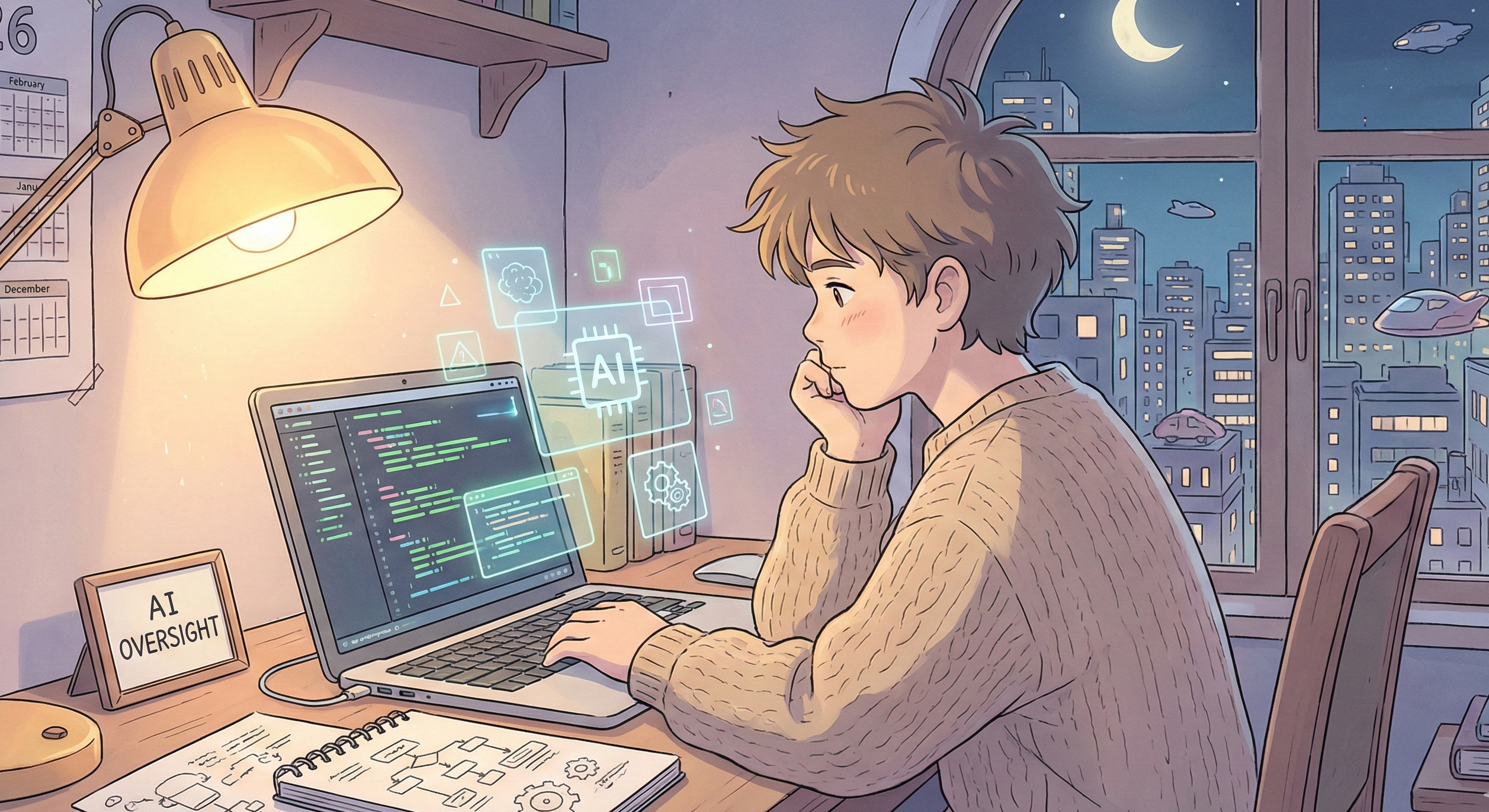
As AI systems started writing working code, fixing bugs, and even clearing technical interviews, fear spread quickly. Students questioned their degrees. Working engineers wondered how long they still had.
But software engineering in 2026 tells a very different story.
The job didn’t disappear. It changed direction.
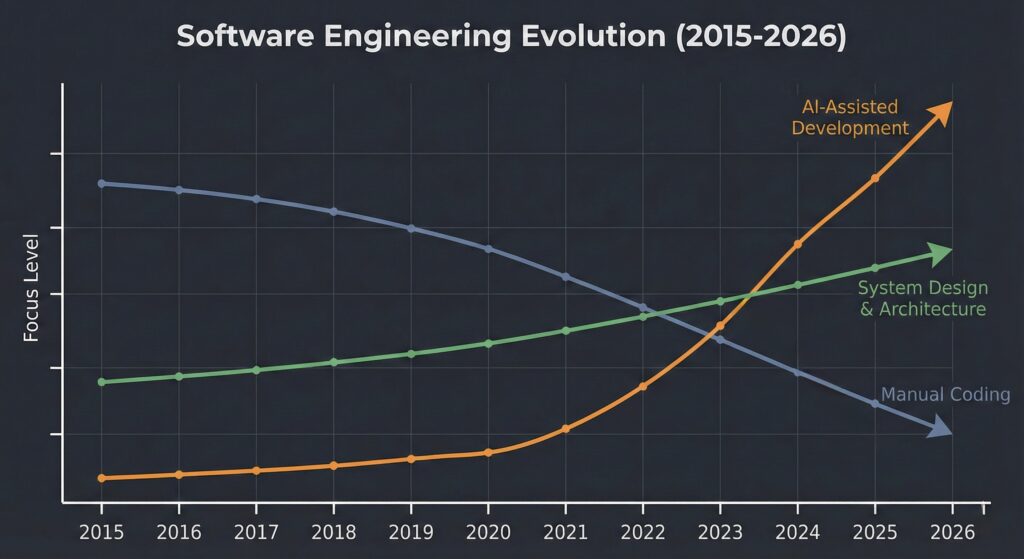
Typing code is no longer the main bottleneck. Defining the right problem, designing the right system, and making sure it doesn’t break in the real world—that’s where the work now lives.
But software engineering in 2026 tells a very different story.
The job didn’t disappear—it changed shape. Writing code is no longer the hardest part of the work. The real challenge now is understanding the right problem, designing systems that make sense, and ensuring the software holds up when real users, real data, and real mistakes enter the picture.
From Writing Code to Making Decisions
In the past, most of an engineer’s time was spent writing code line by line. Today, AI coding tools handle much of that mechanical work: boilerplate, scaffolding, refactoring, even test generation.
What replaced it is heavier work.
Engineers now spend more time thinking than typing. You review AI-generated code, question assumptions, test edge cases, and decide whether something is safe to ship. The mental load has gone up, not down.
This is why fewer lines of code often signal better engineering in 2026. Every line is a liability that must be maintained, secured, and understood later.
The Shift from Author to Architect
The biggest change in modern software engineering is the move from author to architect.
AI can generate implementation details cheaply and instantly. What it cannot do is decide what should exist.
Your role is to define the system:
- What data flows where
- What must never fail
- What trade-offs are acceptable
- What constraints cannot be violated
If those boundaries are unclear, AI will still produce code—but it will be fragile. Clean on the surface, broken underneath.
Think of yourself as a guardrail, not a typist. The better your specifications, the better the output. This is not prompting—it’s engineering.
The Context-First Way of Building Software
Most teams now follow a context-first workflow.
Instead of opening an editor and writing code immediately, engineers begin by defining constraints:

- Performance limits
- Cost ceilings
- Security requirements
- Compliance rules
Only then does AI step in to propose an implementation.
This pattern closely mirrors what we explained in our earlier article on how computer science has evolved in the AI era—coding became cheaper, but reasoning became more valuable.
AI in Software Engineering: Use It, Don’t Trust It
A hard lesson the industry learned is this:
AI predicts patterns. It does not understand consequences.
AI can suggest five valid-looking solutions to the same problem. It cannot tell you which one aligns with your users, budget, legal obligations, or failure tolerance.
Architecture remains human work because it requires judgment under uncertainty.
You can let AI write code. You cannot let it decide:
- Whether speed matters more than consistency
- Whether downtime is acceptable
- Whether a dependency is worth the risk
The correct mindset is simple: trust the speed, verify the logic.
What Changed for Junior Developers
One of the loudest fears was that junior developers would vanish.
They didn’t—but the expectations changed.
Junior engineers are no longer hired to fix small bugs or write simple features. AI already does that. Instead, juniors are expected to:
- Debug unfamiliar systems
- Understand how services interact
- Explain why something failed
The learning curve is steeper, but also more meaningful. Mentorship now focuses less on syntax and more on reasoning.
If you can’t explain what code is doing, AI-generated or not, you don’t control it.
Where AI Coding Tools Still Fall Short
Despite the progress, AI coding tools are far from perfect.
1. Context Blindness
AI struggles with large, messy codebases. Legacy systems contain undocumented rules, historical decisions, and hidden dependencies. AI often can’t see enough to make safe changes.
2. Security Risks
AI tends to suggest popular solutions, not secure ones. Without review, outdated libraries and unsafe patterns slip into production. This is why many teams now cross-check AI output against established security resources like OWASP.
3. Over-Engineering
Because generating code is easy, teams sometimes build complex systems for simple problems. Complexity feels cheap—until you have to maintain it.
Real-World Software Is Still Messy
Production systems are not clean examples from tutorials.
They include:
- Partial migrations
- Conflicting requirements
- Legacy data formats
- Human mistakes
AI performs best in clean environments. Real systems aren’t clean. That gap is where human engineers remain essential.
This is also why system design fundamentals still matter deeply. Understanding how databases scale, how networks fail, and how errors propagate is what separates safe systems from fragile ones.
Why Code Is Now a Liability
In software engineering in 2026, code is no longer an asset by default.
Every line must be:
- Reviewed
- Secured
- Maintained
- Understood by someone later
Because AI allows massive volumes of code to be generated quickly, technical debt can accumulate faster than ever. Teams that don’t enforce strict review processes pay for it later.
The best engineers use AI to write less code, not more.
The Skills That Actually Matter Now
If you’re planning your career around software engineering in 2026, focus here:
- System architecture
- Debugging distributed systems
- Security fundamentals
- Reading and reviewing code you didn’t write
Syntax matters—but only as a foundation. Judgment is what differentiates professionals now.
Conclusion
Software engineering in 2026 is not about typing faster. It’s about thinking deeper.
AI removed the mechanical friction of coding, but it did not remove responsibility. Engineers are now architects, reviewers, and decision-makers. The cost of syntax is low. The cost of bad judgment is higher than ever.
The profession didn’t shrink. It matured.
Table of Contents
Frequently Asked Questions
Will AI replace software engineers in 2026?
No. AI replaces repetitive implementation, not system design, accountability, or judgment.
Is software engineering still a good career?
Yes. But the role favors people who understand systems, not just syntax.
Do I still need to learn coding deeply?
Absolutely. You can’t verify or debug what you don’t understand.
What is the biggest risk of AI coding tools?
Confidently wrong code—logic errors and security flaws that look correct at first glance.
What should beginners focus on now?
Foundations: system behavior, debugging, architecture, and security—not just frameworks.